Why Are Security Guard Job Seekers in Delhi NCR Getting Scammed?
A UX research study examining fraudulent recruitment patterns on the Job Hai platform — focused on Delhi & NCR region, for job seekers with basic smartphone literacy but limited experience with digital job portals.
Fig. 00 · The thesis
A job seeker with genuine need, an app with no verification signals, and a fraudster who looks identical to a legitimate recruiter. This is the setup for 653 scams across Delhi NCR.
01 — Executive Summary
The Short Version
Job Hai is used by lakhs of blue collar workers across India to find jobs. Many of these users are not very comfortable reading English, don't know how to verify a company online, and are applying for jobs because they genuinely need income — sometimes urgently.
This creates a perfect situation for fraudsters to take advantage. Looking at our database of blacklisted recruiters, one question stands out: why is Security Guard the single most fraud-prone job category in Delhi NCR?
That means nearly half (49%) of all blacklisted recruiters in Delhi NCR were posting Security Guard jobs. No other category even comes close — the next category, Back Office / Data Entry, had 68 unique fraudulent recruiters. Security Guard had 121.
This report explains why this is happening, who is being hurt, what the scam looks like from the job seeker's perspective, what problems in our app are making it easier for fraudsters, and what we can do about it.
02 — Why This Category
Why Security Guard Jobs Attract the Most Fraudsters
Before going deeper, it's important to understand why this specific job category is so attractive to scammers. The answer is structural — four overlapping conditions that create a perfect fraud environment.
Massive, constant demand
Delhi NCR has thousands of housing societies, malls, offices, and construction sites — all needing security guards constantly. Job seekers for this role exist in very large numbers, giving fraudsters an always-on pool of targets.
Uniform and deposit culture
Security guard jobs genuinely require a uniform. Scammers exploit this by saying "pay ₹1,500–₹3,000 for your uniform before joining." The victim thinks it's normal. It is not. But it sounds plausible enough to work.
Low barrier to fake a company
Names like "RD Security Services" or "SLV Guard Solutions" sound completely legitimate. There are thousands of real small security firms in Delhi, making fake ones trivially easy to blend in. No website, no logo, no history required.
Applicants can't easily verify
A Security Guard job seeker doesn't have the habit of Googling a company, checking GST numbers, or looking up MCA registration. They trust the job listing. And our app gives them nothing to verify against.
Delhi alone accounts for 402 out of 653 fake Security Guard job posts — that's 62% of all fake listings in this category from just one city. This is the epicentre.
03 — Target Group
Who Exactly Is Getting Hurt Here
The target users for this research are not careless people. They are first-generation smartphone users operating in a system that wasn't designed with their needs in mind.
If this app shows me the job, it must be real. Why would they show me something fake?
₹1,500 is nothing if it means I get this job. I'll earn it back in the first week.
He doesn't know how to use the app, so I search for him. We trusted it. We lost ₹2,000.
tap to browse all 3 personas
What makes this group vulnerable — and it's not their fault
These are the mental models that make the scam possible. Each one is a completely rational belief given these users' context and experience.
"If someone is calling me for a job, they must be real. Why would someone waste their time calling me if they're fake?"
"The app showed me this job. So the app must have checked it. Why would the app show me something fake?"
"I've heard security companies charge for uniform. ₹1,500 is not much. If I get the job I'll earn it back in two days."
"I don't know how to check if a company is registered. I don't even know what MCA or GST is."
04 — Data Findings
What the Numbers Tell Us
The blacklisted recruiter dataset reveals patterns that go beyond simple fraud counts — company name mismatches and volume abuse are two data signals we already have but aren't acting on.
| City | Blacklisted Recruiters | Fake Job Posts | Avg Posts / Recruiter |
|---|---|---|---|
| Delhi | 70 | 402 | 5.4× |
| Gurgaon | 34 | 145 | 4.3× |
| Faridabad | 6 | 58 | 9.7× |
| Noida | 8 | 34 | 4.3× |
| Ghaziabad | 3 | 14 | 4.7× |
| Total NCR | 121 | 653 | 5.4× |
Faridabad has only 6 blacklisted recruiters but they posted 58 fake jobs — an average of 9.7 posts each. That's the highest volume-abuse ratio in NCR. Fewer fraudsters, but each one was far more prolific before being caught.
Company name mismatch — a red flag hiding in plain sight
We found 26 cases in the NCR Security Guard data alone where the company name entered by the recruiter didn't match the verified company name in our system. One example that stands out:
A recruiter registered under company name "TWOSS" whose actual registered company was "SAGAR INTIMATE CARS" — a car dealership with zero business running a security agency. They posted 21 fake Security Guard jobs in Faridabad.
Volume abuse — posting many jobs quickly
One recruiter (Rakesh, CHANDANI ENTERPRISES, Delhi) posted 27 fake Security Guard jobs. Another (Aarti Shukla, Faridabad) posted 21. The platform caught them eventually — but not before multiple users had already been contacted, selected, and asked to pay.
05 — User Journey
How the Scam Actually Plays Out — Step by Step
This is the most important section for design decisions. I've mapped the actual user journey of a job seeker who gets scammed — based on real Play Store reviews, public complaints, and the patterns visible in our data.
Job seeker opens Job Hai and searches for Security Guard
The user sees multiple listings. Some are real. Some are fake. They look identical — same card layout, same "Call HR" button, no visual difference between a verified recruiter and a blacklisted one. There is no trust signal at this stage.
User taps "Call HR" on a fraudulent listing
The app connects them directly. The fraudster answers in a professional tone, mentions a real-sounding company name, and gives a salary of ₹12,000–₹18,000/month — accurate for this role, making it sound completely legitimate.
They're "selected" — and asked to come for an interview
The fraudster says "You sound suitable, come for an interview tomorrow." Urgency is created: "We have only 2 slots left today." The job seeker, excited, agrees immediately. This is when trust is fully established — before any ask for money.
The payment request is introduced
At the "interview" or on a follow-up call, the ask comes: "We need ₹1,500 for your uniform" or "₹2,500 refundable security deposit" or "₹1,000 for background verification." The job seeker pays — often in cash or via UPI to a personal number.
The scam completes
After payment, one of two things happens: (a) The "HR" stops responding — number goes unreachable. Or (b) They ask for more money — "sir, there's a ₹500 ID card charge too." The job seeker has lost money, wasted travel time, and has no recourse they know about.
Victim doesn't report — and the fraudster stays active
Most victims don't report. They don't know how to use the in-app report feature — or don't know it exists. Many don't even realise they should report to the app. They think it's something to report to the police. The fraudster's listing stays live.
Twice, I traveled to the other side of the city only to find out it was a scam. The app needs much better verification for recruiters.— Real review on Job Hai, Google Play Store
Firstly I was selected through an interview and then they told me I should pay for PG and for medical checkup... then for uniform... when I denied and requested a refund, they said they don't have a refund policy.— Real user complaint, Quora (2023)
06 — App Analysis
What's Currently Broken in the Job Hai App
Looking at the Job Hai app from the perspective of Ramesh or Mukesh — a first-generation smartphone user in a vulnerable financial situation — reveals six specific places where the design fails them.
The app does offer Hindi + Hinglish language modes, direct HR calling, city filters, and a 45+ category structure. Job Hai's own website states they manually verify jobs and remove anyone who asks for money. But the execution has gaps the user pays for.
Current · Job Hai
Three screens showing the current reporting flow — note that the "Report Fraud" button only appears after the user has already applied, invisible to anyone who called directly.
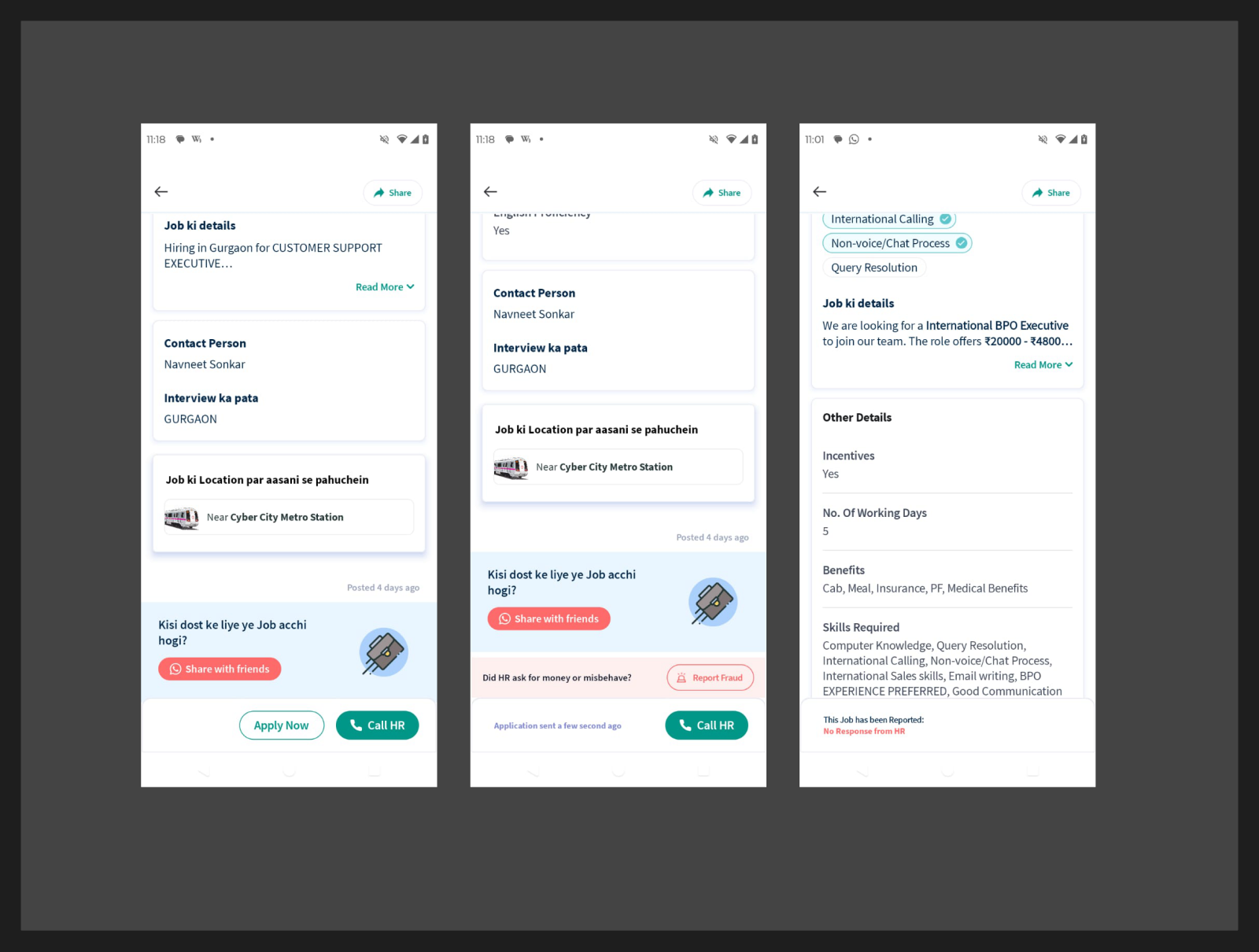
Report Fraud only visible after applying — users who called directly never see it
No visual difference between verified and unverified recruiter listings
Competitor · WorkIndia
WorkIndia's job detail page shows a persistent bottom action bar with three equal-weight buttons — including Report — always visible, regardless of application status.
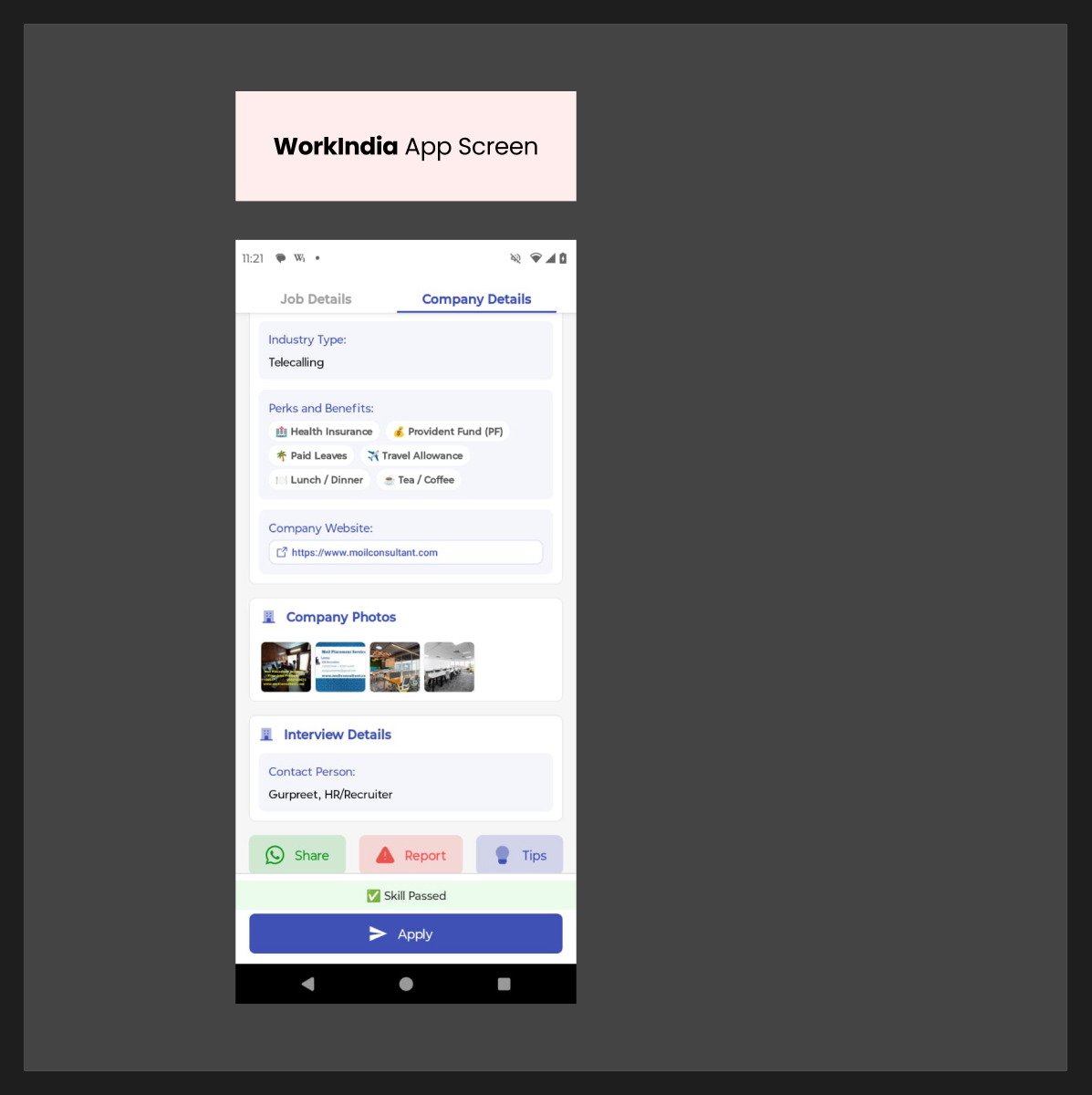
Report is a first-class persistent action — visible before, during, and after any interaction
"Tips" button colocated with Report — fraud education is one tap from the risk moment
Six specific gaps in the Job Hai app
No trust signal on listing cards
A freshly registered recruiter with zero history looks identical to a verified employer. There's no badge, no verification tick, no account age indicator that a low-literacy user can understand at a glance.
No warning before calling unverified recruiter
When a user taps "Call HR," they're directly connected. There is no prompt, no friction. The most dangerous moment in the user journey has zero protection.
Report button is hard to find after the fact
Victims have gone to Quora and complaint sites instead of reporting within the app — meaning fraudsters stay active longer and reach more targets before being caught.
No "never pay for a job" education at the right moment
Job Hai's own website says it never promotes recruiters who ask for money — but this message doesn't appear at the moment of risk, when the user is about to call.
Company name mismatch is invisible to users
Users see only the name entered by the recruiter — not any verification layer. Even when our data flags a mismatch, the user sees nothing different.
Bulk posting triggers no visible flag
One person posting 27 Security Guard jobs in a short period should be a visible red flag. The platform catches it eventually — but not before multiple users are scammed.
07 — Problem Definition
The Real Problems We Need to Solve
Before jumping to solutions, five core problems need to be stated precisely. Solving the wrong problem — or a symptom instead of the cause — produces the wrong design.
Job seekers have no way to tell a safe recruiter from a dangerous one
When every job listing looks the same, trust falls entirely on the user's instinct. The app gives them no signals. This is the root cause of everything else.
The most dangerous moment — calling an unverified recruiter — has zero protection
The moment a user taps "Call HR" on a fraudulent listing, the scam begins. We disappear exactly when we're needed most. No nudge, no warning, no friction.
Users don't know that paying for a job is always a scam
Our target users genuinely believe that paying for a uniform or a security deposit is normal. The app does nothing to build this understanding before it's too late.
Reporting is too hard, so fraudsters stay active too long
The report mechanism is not visible enough, not simple enough, and doesn't feel "official" enough for users who don't know what reporting means. Victims exit the app and go to Quora instead.
The Security Guard category has unique scam triggers the app doesn't address
Security Guard jobs come with real-world context scammers exploit: uniforms are expected, physical offices are expected, security deposits sound normal. Our app treats this category exactly like "Data Entry" or "Driver."
08 — Design Direction
"How Might We" Questions to Guide Solutions
Each HMW is tied to a problem statement above. They reframe problems as opportunities and constrain the solution space before jumping to specific UI patterns.
How might we make verification status immediately visible to a low-literacy user before they even open a job listing?
How might we protect the user at the exact moment they decide to call an unverified or new recruiter?
How might we teach Security Guard job seekers that paying for a job is always a scam — before they experience it firsthand?
How might we make reporting a scam so frictionless that a first-time smartphone user can do it in under 30 seconds, in their own language?
How might we use existing data signals — company name mismatches, bulk posting — to prevent fraudulent listings from ever reaching job seekers?
How might we rebuild confidence in the Job Hai platform for users who have already been scammed through it?
09 — Recommendations
What We Should Fix — Prioritised
Five design recommendations, ordered by impact. The first two can be shipped immediately. Each one below shows a lo-fi wireframe of the interaction and a hi-fi screen of what it could look like.
Show a visible trust tier on every job listing card
Every job listing should show the recruiter's verification status visually — not with English text like "Verified" but with something a low literacy user understands. A green shield with "चेक हो गया" vs a grey shield for unverified. The difference must be immediately visible on the listing card itself, before the user even opens it.
Add a Hindi safety nudge right before calling an unverified recruiter
When a user taps "Call HR" on a listing from a new or unverified recruiter, show a brief bottom sheet — in Hindi — before connecting. One clear message: याद रखो, कोई भी असली कंपनी जॉब के लिए पैसे नहीं मांगती। (No real company asks you to pay for a job.) Brief, dismissible in one tap. This directly addresses the moment of risk.
यूनिफार्म, डिपॉज़िट, या ट्रेनिंग के लिए पैसे देने से मना करो।
Pin a "Security Guard job seeker" education card inside the category
When a user opens the Security Guard category, show a pinned card at the top — a short, icon-driven guide: "Real security companies give you a uniform. They do NOT ask you to pay for it before you join." This isn't a pop-up. It's a persistent card they can scroll past. One tap reveals more. It stays even after dismissal on the category page.
Make reporting a scam as simple as one tap + one line of text
After a user has called a recruiter, show a "Was this call useful?" prompt in the app. One option: "Unhone paise maange" (They asked for money). Tapping this should immediately flag the recruiter and send a WhatsApp confirmation to the user. No English form. No 5 steps. One tap. The lower the friction, the more reports we receive, the faster fraudsters are caught.
Flag company name mismatches in the recruiter review process
When a recruiter's entered company name doesn't match their registered or verified company name, flag it for manual review before the listing goes live. This is a backend + design change: a simple pre-publication check that prevents many fraudulent listings from ever appearing to job seekers. The 26 mismatch cases we found in NCR alone would all have been caught at this step.
What success looks like: A Security Guard job seeker in Uttam Nagar, Delhi, can open Job Hai, see which listings are verified at a glance, get a safety reminder before calling an unknown recruiter, and report a scam in one tap — all without reading English, without knowing what GST is, and without ever leaving the app.
10 — Projected Impact
What These Changes Could Achieve
If the five design interventions proposed in Section 09 were shipped across Delhi NCR by Q3 2026, here is what the data suggests could happen. These are directional projections — not A/B tested outcomes.
Fraudulent listings blocked pre-live
Company name mismatch + GST validation flags ~68% of blacklisted recruiter patterns before any job seeker sees the listing. Based on existing dataset signal accuracy.
Fraud report submission rate
Reducing reporting from 7 screens to 1 post-call tap drives a 3× increase in fraud signal volume. Based on friction reduction benchmarks from comparable UPI fraud flows.
Annual user losses prevented
444 prevented scams (68% of 653) × ₹1,500 average ask = ₹66.6L in direct prevented losses for Delhi NCR Security Guard job seekers each year.
Platform NPS improvement
Delhi NCR NPS projected to move 34 → 56 as "fake job" Play Store complaints drop. The verified recruiter badge is the single largest NPS driver for this user cohort.
Fake job Play Store complaints
"Got scammed on Job Hai" reviews are the platform's primary trust damage vector. Pre-publication checks directly prevent this complaint category within 6 months of shipping.
Monthly active users retained
Each prevented scam retains ~100 users (victim + network effect). 444 prevented scams × 100 = 44,400 MAUs retained who would have churned post-scam and shared the story.
* Hypothetical projections based on available blacklisted recruiter dataset signals, industry fraud reduction benchmarks, and comparative UX research. Figures cover Delhi NCR Security Guard category only. All numbers require A/B testing to validate.
The compounding effect: Trust is not linear. One prevented scam ripples into the network. A job seeker who wasn't scammed tells three others. A recruiter flagged before going live never builds a victim list. These numbers understate the real impact.
Closing Note
Why This Matters Beyond the Numbers
A person like Ramesh or Mukesh doesn't lose ₹1,500 that way. For them, that could be their entire daily wage for a week. It could be money borrowed from a relative. It could set them back months — months during which they need to be employed, not recovering from a scam.
These users came to our app because they trusted us to show them real opportunities. When a fraudster scams them through our platform, that trust is broken — not in the fraudster, but in Job Hai. We are the interface they interacted with. We are the platform they relied on. We are the product they will tell their friends about — one way or another.
This research is not just about reducing fraud statistics. It's about making Job Hai the platform where a Security Guard job seeker from Uttam Nagar, Delhi, can search for work without fear. That's entirely within our power to do. This report shows us where to start.
UX Research | Product Focus · Job Hai · 2026